Upholstery Fabric Selection for Hospitality Projects: Double Rubs and FR Compliance
Every hospitality project carries a different set of demands — a high-end resort needs fabrics that endure daily guest use while maintaining aesthetic appeal, a boutique hotel demands tactile luxury with easy maintenance, and a large-scale convention center requires materials that survive years of near-constant traffic. Upholstery fabric is one of the most critical decisions a spec writer, FF&E buyer, or project developer makes during the sourcing phase. Get it right, and the furniture performs across its intended lifecycle. Get it wrong, and warranty claims, replacement costs, and reputation damage follow.
Two technical pillars dominate this decision: abrasion resistance measured in double rubs, and fire resistance governed by regional regulatory codes. Understanding both — and how they interact with material choice, production quality, and supply chain reliability — is what separates a specification that lasts from one that fails within months.
Why Hospitality Fabric Demands Exceed Residential Standards
Hospitality environments operate on timelines and intensity levels far beyond typical residential use. A single lobby sofa may see 30 to 50 people sitting on it daily, exposed to spills, sunlight through floor-to-ceiling windows, and repeated cleaning cycles with commercial-grade chemicals. Guest room seating faces similar stress, compounded by luggage scuffs, pet hair from service animals, and the inevitability of accidental stains.
In our experience across 125+ export markets, we see consistent patterns in fabric failure. The top causes are premature fade from UV exposure, seam failure from inadequate stitching standards, color loss from harsh cleaning, and regulatory non-compliance discovered during fire inspections at project handover. These are not theoretical risks — they are documented project delays that affect delivery schedules and budget allocations.
Double Rub Testing: What the Numbers Actually Mean
The double rub is a standardized measure of fabric abrasion resistance. A testing machine moves a cloth back and forth across the fabric surface — one complete back-and-forth cycle equals one double rub. The result is expressed as the number of cycles the fabric withstands before visible wear appears, typically defined as significant fiber breakage or noticeable pilling.
Wyzenbeek vs. Martindale: Choosing the Right Standard
The Wyzenbeek test is standard in North America for woven fabrics, using a cotton duck cloth as the abradant. The Martindale test, common in Europe and international markets, uses a wool dam fabric and measures cycles to thread breakage or visible wear. Both are valid, but they are not interchangeable. A fabric rated at 30,000 Wyzenbeek does not equal 30,000 Martindale — the methods use different abrasives and end-point definitions.
Performance Thresholds by Application
| Application | Minimum Double Rubs (Wyzenbeek) | Recommended Double Rubs (Wyzenbeek) |
|---|---|---|
| Light-duty seating (private offices, meeting rooms) | 9,000 – 15,000 | 15,000+ |
| Moderate-duty seating (hotel guest rooms, restaurant banquettes) | 15,000 – 25,000 | 25,000+ |
| Heavy-duty seating (lobby furniture, high-traffic lounges, casino floors) | 25,000 – 50,000 | 50,000+ |
| Ultra-heavy-duty (conference centers, cruise ships, airports) | 50,000+ | 100,000+ |
When specifying, always confirm which test method the supplier cites. A fabric claiming “50,000 Martindale” under Wyzenbeek standards will perform significantly differently. At our factory in Foshan, we require transparent documentation from our mill partners and verify test reports independently before approving any fabric for a hospitality specification.
Fire Resistance and Regulatory Compliance
Fire safety regulation is non-negotiable in hospitality construction. Building codes, local fire marshals, and insurance underwriters all require documented compliance before occupancy approval is granted. The complexity comes from jurisdictional variation — each market has its own testing protocols and certification pathways.
Key Standards by Region
- United States: CAL TB 117 and its successor 117M govern flame resistance for upholstered furniture. California Health and Safety Code Section 19250 also applies to public occupancies. The CBNR (California Bureau of Home Furnishings and Thermal Insulation) maintains the approved testing framework.
- United Kingdom: BS 5852 is the governing standard, requiring ignition source tests for cigarette and flame exposure. BS 7177 sets performance requirements for specific hazard levels in public seating.
- Europe: EN 1021-1 and EN 1021-2 cover ignition sources including cigarettes and small flames. National amendments may impose stricter requirements in individual member states.
- Asia-Pacific: GB standards in China, AS/NZS in Australia and New Zealand, and SBC in Singapore each define local compliance expectations.
- Solid fuel burning: CARB P2 and TSCA Title VI address formaldehyde emissions from composite wood products used in furniture frames and components — relevant when specifying complete upholstered pieces.
It is essential to clarify the target market early in the sourcing process. A fabric compliant with one standard may not automatically satisfy another. Our team reviews the specific code requirements for each project destination and cross-references them against available mill certifications before fabric selection proceeds.
Fabric Materials: Performance Profiles for Hospitality Use
Different fiber constructions deliver different performance profiles. Understanding these distinctions allows precise specification rather than generic “commercial grade” selections.
- Solution-dyed acrylic: Color is embedded during fiber formation, delivering exceptional UV fastness and fade resistance — critical for sun-exposed lobby and poolside seating. Excellent abrasion resistance and color consistency. Common brands include Sunbrella and Barco.
- Polyester: Strong inherent abrasion resistance, good stain repellency, and cost-effective across a wide range. Solution-dyed polyester offers enhanced colorfastness. Widely used in both light and heavy-duty hospitality applications.
- Vinyl / PVC leather: Inherently fluid-resistant, easy to sanitize, and often inherently flame-resistant without chemical additives. Preferred in healthcare-adjacent hospitality environments and high-moisture areas. Can feel less breathable in warm climates.
- Leather and bonded leather: Natural durability and aging characteristics that many luxury hospitality projects require. Genuine leather demands specific maintenance protocols; bonded leather offers consistency at lower cost but different longevity profiles.
- Performance blends: Polyester-nylon combinations and treated cotton blends expand the palette while maintaining commercial-grade specifications. These are increasingly common where designer aesthetics must meet operational realities.
Technical Specifications Beyond Rub Count and FR
A complete fabric specification for a hospitality project extends well beyond abrasion and flame resistance. Several other parameters directly affect procurement, installation, and lifecycle cost.
Weight and construction: Fabric weight (measured in grams per square meter or ounces per linear yard) correlates with density and durability. Heavier construction generally indicates tighter weave and longer service life, though this is not absolute — advanced finishing treatments can enhance lighter fabrics.
Width and pattern repeat: Standard upholstery widths of 54 to 55 inches apply to many commercial rolls. Wider formats reduce seam lines on large seating pieces. Patterned fabrics require attention to repeat measurement — inadequate ordering based on flat area calculations leads to visible mismatch at seams, which is unacceptable in luxury hospitality finishes.
Crocking and colorfastness: Color transfer during initial use (crocking) is a common complaint in hospitality settings. Testing for wet and dry crocking resistance should be part of fabric evaluation, especially for dark-colored and richly saturated textiles.
Cleaning and maintenance compatibility: Fabrics must withstand the cleaning chemicals and procedures specified in the project’s facilities manual. Some fire-retardant treatments degrade under certain cleaning agents, reducing FR performance over time — a factor that must be evaluated during specification.
For a complete view of our technical capabilities and product range, including fabrics engineered for hospitality FF&E projects, explore our product catalog.
Quality Control at the Manufacturer Level
Specification accuracy means nothing if production quality is inconsistent. At ROSY ROSE, every upholstered piece — from contract dining chairs to lounge sofas — passes through 16 inspection checkpoints before leaving our 200,000㎡ facility in Foshan. These checkpoints cover material incoming verification, stitching integrity, frame assembly, fabric tension and alignment, finish quality, and final dimensional confirmation.
This systematic approach ensures that the fabric performance documented in test reports is replicated in every unit shipped. It also means that when a specifier orders 200 chairs for a resort opening, the sixth chair and the two-hundredth chair meet the same standard — no surprises on installation day.
Supporting the Full FF&E Procurement Cycle
Hospitality fabric selection is only one component of a complex procurement process. Importers, distributors, and project developers need partners who understand the full scope — from initial specification through delivery and installation support.
Our capabilities span custom fabric development tailored to project specifications, sample and mock-up production for design review, color library coordination with interior design teams, and consolidated FF&E delivery managing multiple furniture categories in a single shipment. We also support specification-phase inquiries, helping teams validate material choices against local code requirements before orders are placed.
If you are evaluating material options for an upcoming hospitality project, our team is available for consultation at contact. For custom fabric and furniture specifications developed with your design team, learn about our bespoke manufacturing process.
FAQ
What is the minimum double rub rating for hotel lobby seating?
For high-traffic lobby seating, we recommend a minimum of 25,000 Wyzenbeek double rubs, with 50,000 or above ideal for ultra-heavy-use areas. Always confirm the test method — Wyzenbeek and Martindale produce different results and are not interchangeable in specifications.
How do I verify that a fabric meets the fire code for my project’s jurisdiction?
Request the specific test report from the manufacturer, confirming the standard tested against (CAL TB 117, BS 5852, EN 1021, etc.) and the pass/fail results. Cross-reference with your local authority having jurisdiction before finalizing the specification. If the fabric is part of a complete furniture piece, ensure the assembled product — not just the fabric alone — has been tested to the required standard.
Can I source custom fabric developments for a specific hospitality project?
Yes. We work with mill partners to develop custom weaves, colors, and finishes for projects requiring specific aesthetic or performance criteria. Our design house team can assist with fabric selection, sample development, and technical validation throughout the process.
With over four decades of experience serving hotel FF&E buyers, importers, and designers across 125+ countries, we bring that depth of knowledge to every project — so you can specify with confidence and ship with certainty.
Specifications
| Parameter | Specification | Notes |
|---|---|---|
| Overall Dimensions (W × D × H) | 230 × 95 × 78 cm (90.6 × 37.4 × 30.7 in) | Configurable to project requirements |
| Seat Height | 45 cm (17.7 in) | Standard hospitality spec |
| Frame Material | Seasoned hardwood (Eucalyptus / Beech) | Kiln-dried to 8–12% moisture |
| Upholstery Options | Aniline leather, performance fabric, marine-grade vinyl | Double-rub rated options available |
| Finish Options | Lacquered, powder-coated, brushed metal | Custom RAL / Pantone on request |
| Fill | High-resilience foam (35–45 kg/m³), feather blend seat cushions | Fire-retardant compliant |
| Weight (per unit) | Approx. 68 kg (149.9 lbs) | Varies by configuration |
| Packaging | 1 unit per export-grade carton; ~2.1 CBM per 40-ft container | Corner-protected, moisture-barrier wrapped |
| Lead Time | Made to order — lead time applies | See Ordering section |
Materials & Construction
The frame is constructed from kiln-dried hardwood with mortise-and-tenon joinery reinforced at stress points with steel brackets and double dowels — a standard that prevents wobble and joint separation far beyond residential-grade glue-only assemblies. Every piece undergoes 16 inspection checkpoints from raw timber selection through final packaging, ensuring dimensional stability and structural integrity across the project lifecycle.
Seating comfort is delivered through a multi-density foam system: a high-resilience base layer (35–45 kg/m³) provides long-term load retention, while seat cushions are available in a feather-down blend or premium memory foam top for tactile luxury. Upholstery is sourced from our vetted supplier panel — full-aniline leathers meeting hospitality abrasion thresholds, solution-dyed performance fabrics rated 80,000+ double rubs, and Class 1 fire-retardant vinyls. The wooden base receives a 3-stage lacquer process (sealer, primer, topcoat) with UV-stable finish tested against CARB P2 and TSCA Title VI emissions standards.
Where It Works
- Hotel lobby and reception seating areas
- Presidential and suite living spaces
- Members’ clubs and private dining lounges
- Casino VIP lounges and high-traffic gaming floors
- Executive airline lounges and business centres
- Boutique hotel showrooms and design galleries
- Residential project developments (short-stay / serviced apartments)
This piece is specified across light, mid, and heavy-use hospitality environments. Its construction standards meet the demands of public corridors and concentrated guest-traffic zones without compromising the refined aesthetic required in premium room categories.
Customisation Options
- Dimensions: Width, depth, and height adjusted to floor plan and ADA/accessibility requirements
- Upholstery: Full COM (Customer’s Own Material) and COL (Customer’s Own Colour) programmes accepted; fabric swatches shipped on request
- Finish: Wood tone, metal finish, and hardware colour customised to project specification
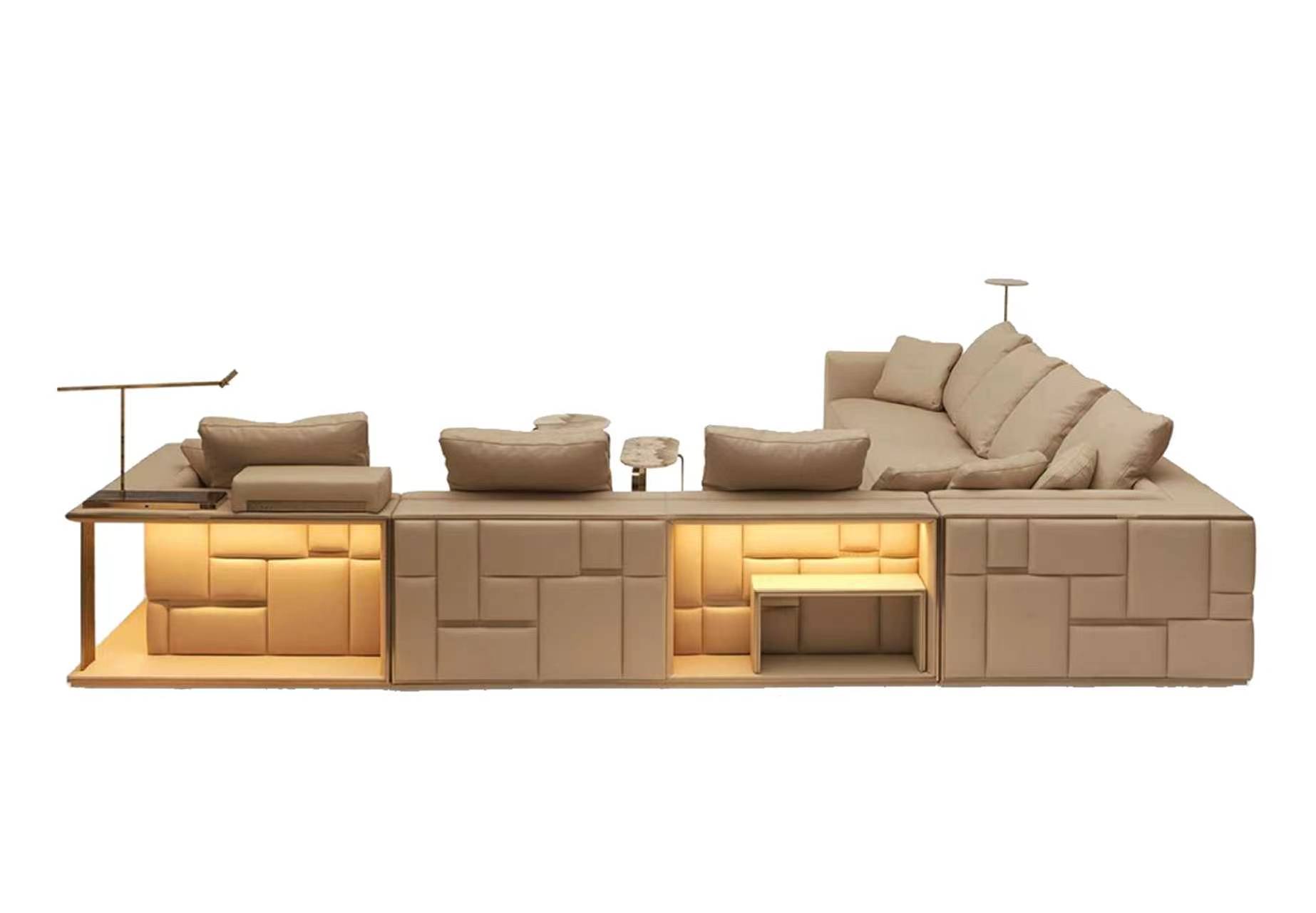
- Layout: Configurations including 2-seat, 3-seat, chaise, and modular sectional arrangements
- Drawings: All custom dimensions confirmed via CAD drawings before production begins
Ordering, Lead Time & Logistics
Project orders have no minimum quantity; however, sample approval is required before bulk production commences. The standard workflow is: RFQ → technical quotation → sample (2–3 weeks) → buyer sign-off → production scheduling. Typical lead time from approved drawing to shipment is 25–35 weeks depending on order volume, fabric lead times, and destination port. We ship FOB Foshan or EXW from our factory, with full export documentation including commercial invoice, packing list, and certificate of origin.
All units are packed in reinforced export cartons with corner protection and desiccant wraps, optimised for container loading to minimise CBM waste. We service project shipments to 125+ countries and coordinate with experienced freight forwarders for LCL and FCL arrangements. Lead times are subject to raw-material availability; order confirmation includes a firm delivery window.
Frequently Asked Questions
What double-rub rating should I specify for a hotel lobby?
For high-traffic public areas such as hotel lobbies and convention centre seating, we recommend a minimum of 50,000 double rubs on performance fabrics, and 80,000+ for near-constant use zones. Leather options are rated by abrasion class rather than double rubs; our hospitality-grade full-aniline leathers meet or exceed the highest commercial classifications. We can provide test reports from accredited labs on request.
Do you accept COM (Customer’s Own Material)?
Yes. We welcome COM and COL submissions on all project orders. Please send fabric rolls or approved swatches to our Foshan facility for evaluation before signing the purchase order. Our team will confirm compatibility with the frame construction, flame-retardancy requirements, and double-rub targets before production begins.
What fire-retardancy compliance do your products meet?
Our upholstery and foam systems are available to meet multiple regional fire standards, including CAL TB 117, BS 5852, EN 16139, and others depending on the project destination. Specific compliance is confirmed at the quotation stage based on the target market. All foam used in our hospitality range is inherently fire-retardant or treated to meet the applicable code.