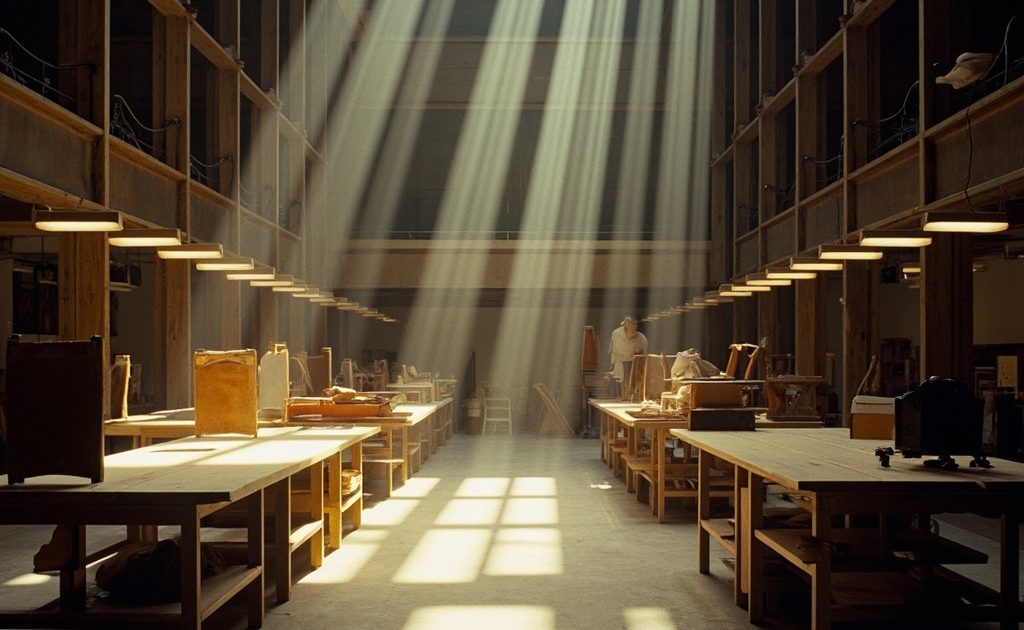
Visitors to Rosy Rose usually expect to find a factory. What they find, spread across the 200,000 square metres of our Foshan campus, is something closer to a small city built around a single idea — that a piece of furniture should be handled with more care than it strictly needs. Walk through it once and the impression is less of production than of rehearsal: the same motions repeated until they become second nature, the same standards applied until no one has to think about them.
Very little of the work happens in silence, and none of it happens fast. That is the first thing a new visitor notices, and it is the best summary of what a day here looks like.
Morning Begins With the Leather
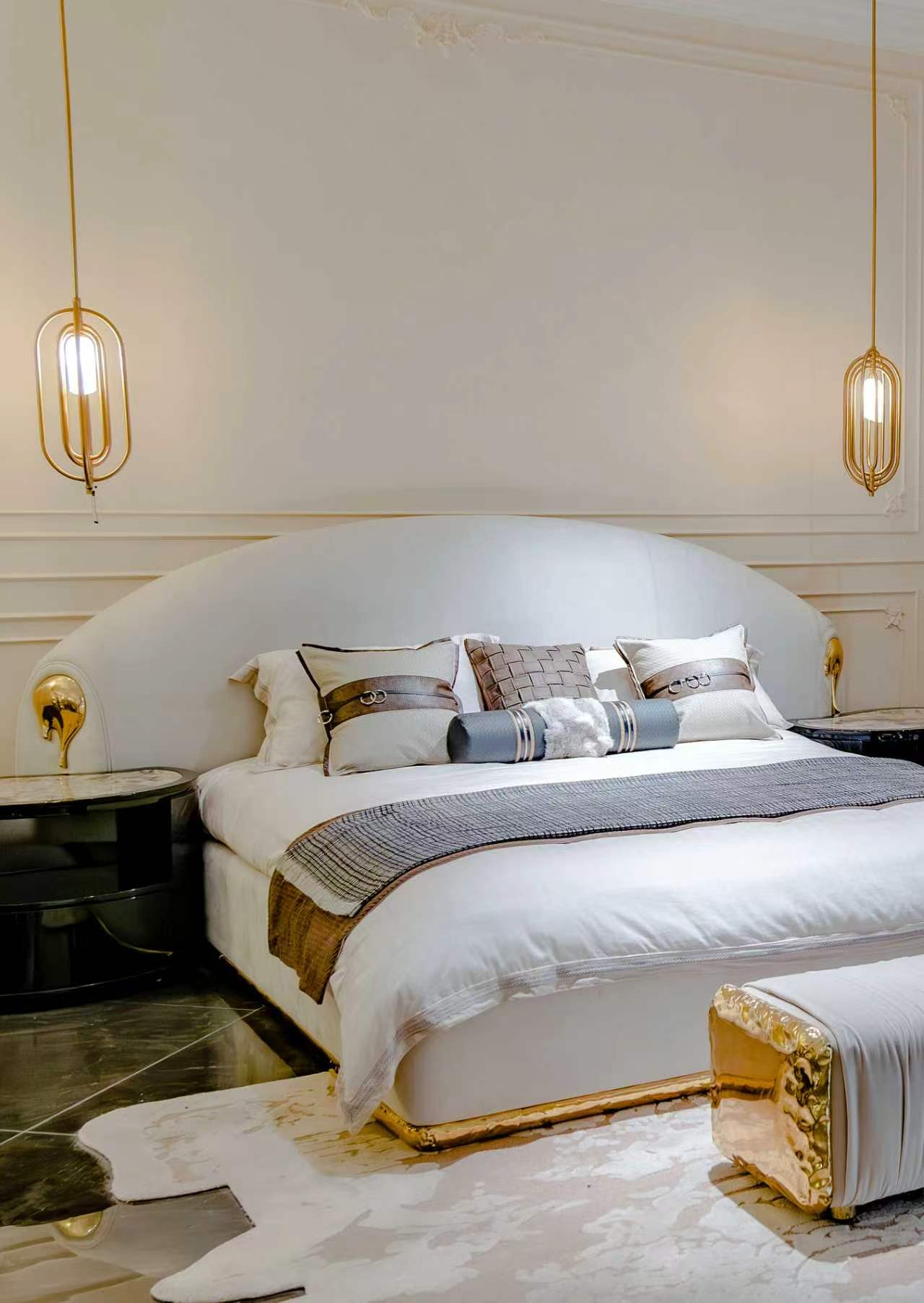
The atelier wakes early, and it wakes in the material store rather than on the production floor. Before any cutting starts, the day’s hides are brought out and inspected under strong, even light. Full-grain leather — whether the supple Nappa or the more translucent aniline that lets a hide’s natural marking show through — is a living material. No two skins are identical. A morning’s work begins with a judgment call: which panel of this hide is worthy of the headboard being cut today, where the natural character adds something, where it would compromise the piece.
This is not a step that can be skipped or rushed, and it is the reason our leather goods rarely show the bored, uniform perfection of machine-era furniture. A craftsman decides. That decision shapes everything that follows.
From the store, the hides move to the cutting benches, where the day’s real rhythm takes hold. Cutting leather for upholstery is a different discipline from cutting timber. The hide has a nap, a grain direction, a stretch that must be read and respected, or a chair will sag and pull out of true within a season. Our cutters work with a deliberate slowness that would look strange to an outsider — measuring, turning the skin, laying a pattern, then re-checking before the blade ever touches. Speed here is not a virtue; a single wasted hide is a waste of an animal and a day.
The Midday Floor
By midday the workshops are fully alive, and the character of the day splits along the material being worked. This is the part of the tour that surprises people most, because there is no single sound to the place. Timber saws groan in one hall; in another, the work is nearly silent, just the soft pull of a seam being eased through full-grain leather by hand, and the faint ticking of the industrial sewing machines that only begin the work — the finishing and topstitching still falls to human hands.
In the wood shops, walnut, oak, rosewood and the darker, streaked drama of macassar ebony are shaped, jointed and sanded. Sanding is the unglamorous heart of fine furniture, and it is done here in ascending grits until a surface feels almost soft to the touch — the point at which timber stops being wood and becomes something closer to velvet. It is tedious, thankless work, and it is non-negotiable. A surface that is not properly prepared will never hold a good finish, no matter how expensive the oil or lacquer applied later.
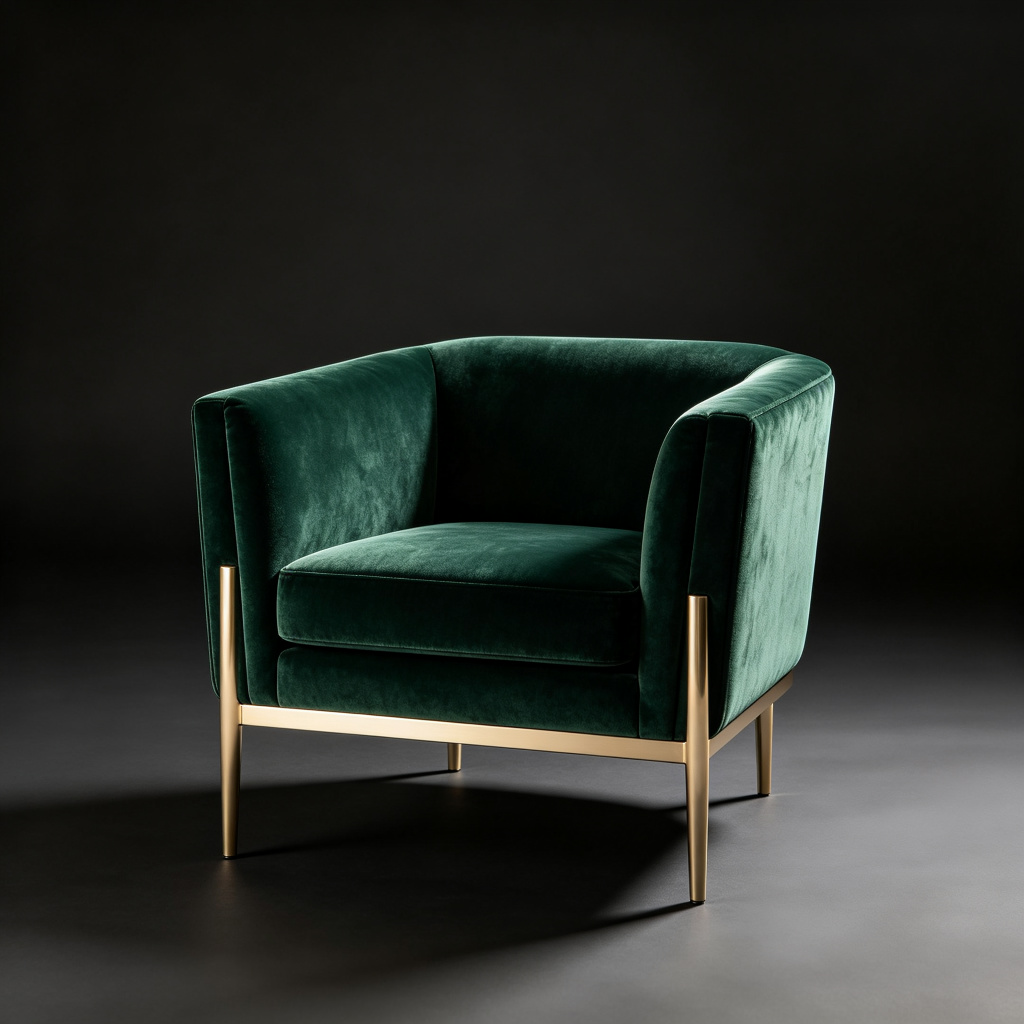
Off to one side, away from the dust, the finishing bays hold the day’s quieter work. This is where “100% hand finished” becomes visible. Brushed and antique gold hardware is mounted and checked; book-matched Carrara and Calacatta marble tops are set, their veining aligned the way a museum would align a triptych; velvet and bouclé panels are eased into frames and checked for the flatness of their pull. Every piece, before it is allowed to move toward the showroom, is examined by hand and eye at least once more than is strictly necessary.
The Showroom at the Heart
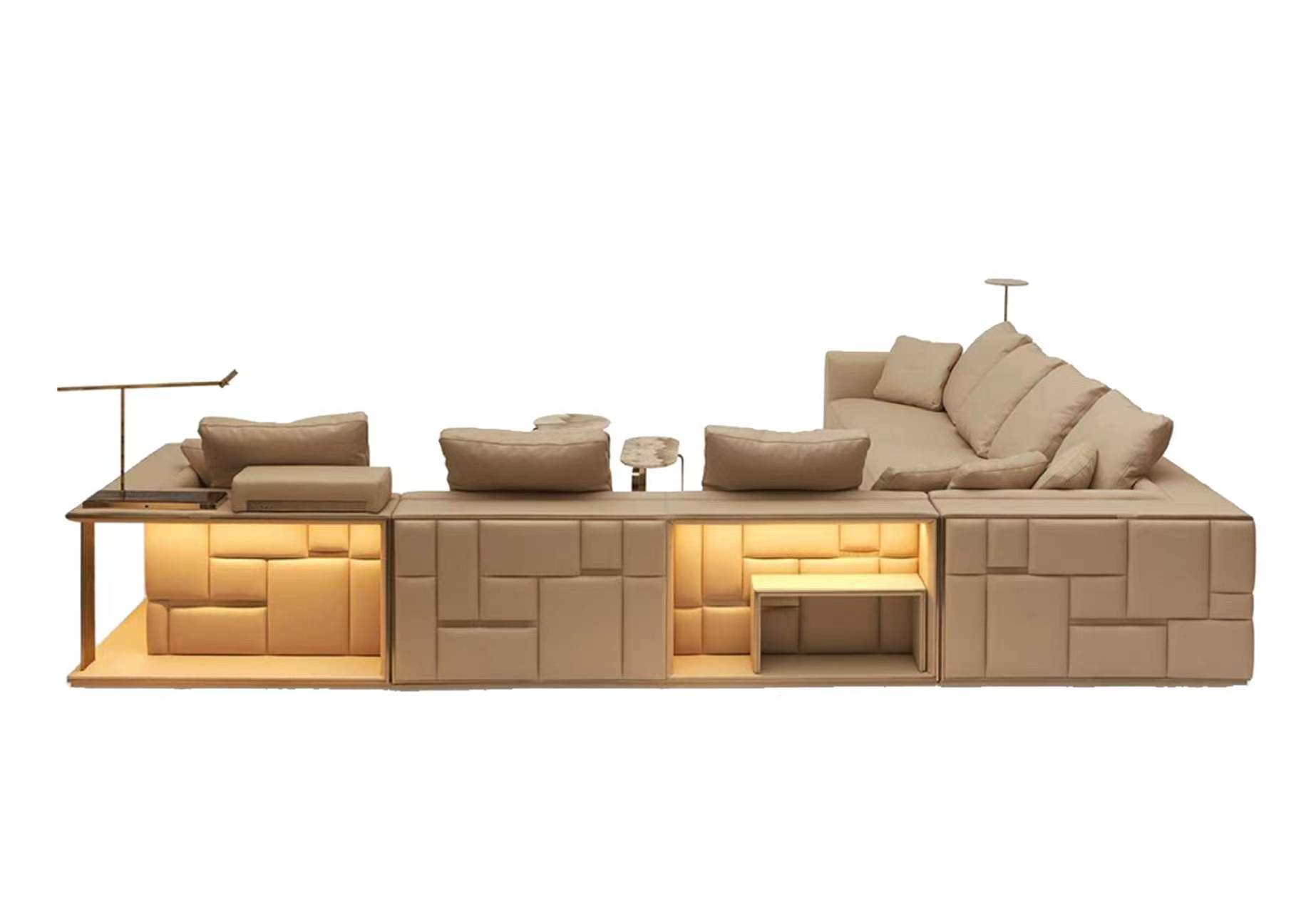
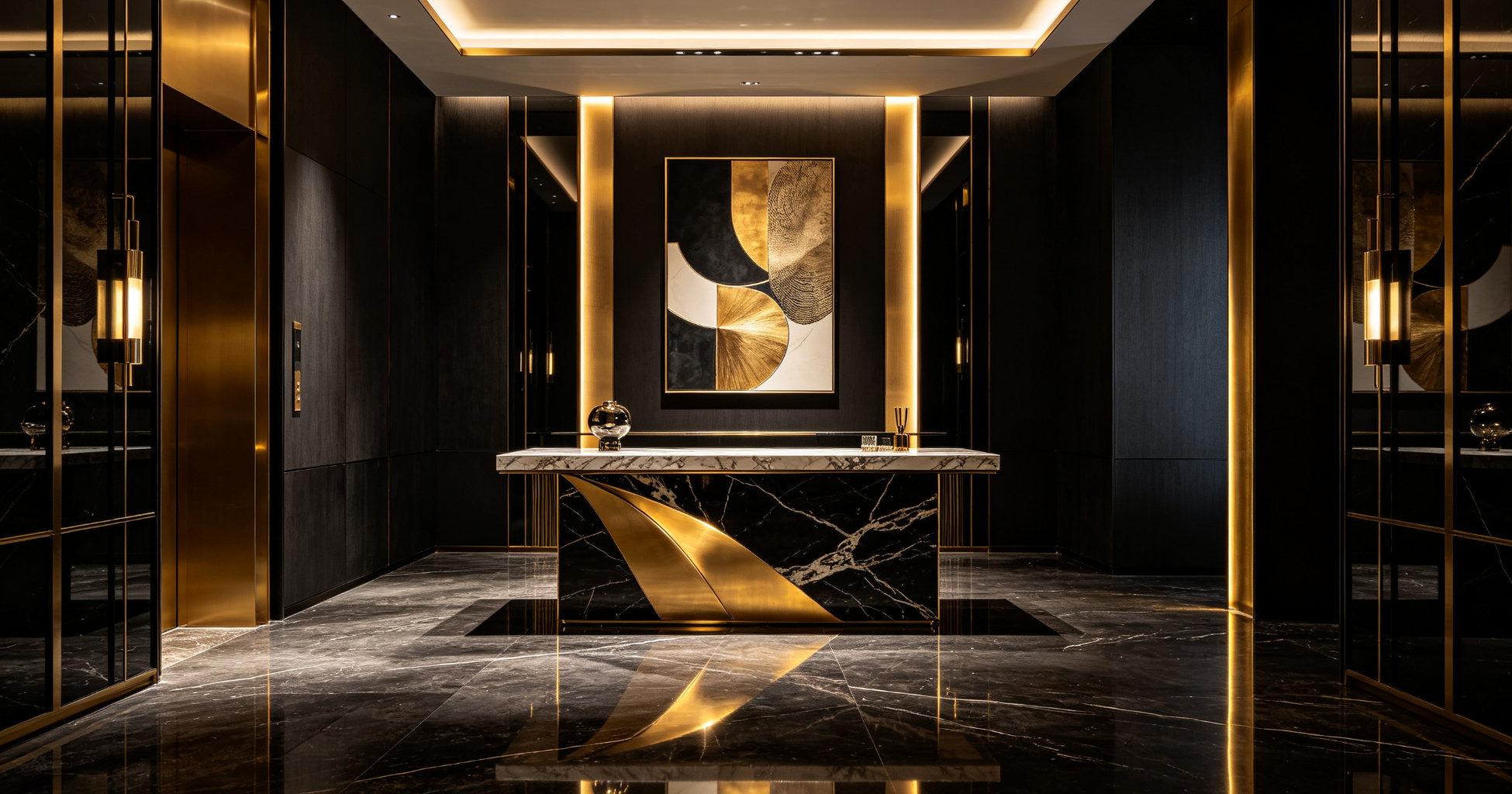
At the centre of the campus sits the 10,000-square-metre showroom. It is not, in the usual sense, a place where goods are displayed. It functions more as the conscience of the workshop — the point where the day’s output is judged not by production targets but by how it reads in the light of a real interior, at the scale a client will live with.
Designers and private clients from the Middle East, Europe and the United States walk these rooms, and their reactions shape the following weeks of work. A proportion that looked right on the bench can look wrong in the showroom’s natural light; a finish can reveal itself as too glossy, too flat, or exactly right. Because we build for clients across more than fifteen countries, the showroom also serves as a living lesson in how the same design language travels — what a client in one market expects of a silhouette, how another market reads the warmth of a wood.
By late afternoon the work has slowed, not out of fatigue but out of the discipline of finishing a day without rushing its end. Evening light is unreliable for judging colour and surface, so the final inspections tend to cluster while the light is still honest. The last act of the day is often the simplest and most human: a craftsman runs a hand across a freshly finished surface, checks a seam by touch, and nods. That nod is the real quality control. No checklist, no signed ticket, no computerised tolerance — just the judgment of someone who has done this long enough to know when a piece is right.
Where Machines Earn Their Place
It would be a mistake to read this as a rejection of machinery. The visitor who assumes a hand-finished workshop must be full of men with hand planes and chisels is picturing a museum, not a working atelier. A Rosy Rose day is full of machines doing exactly the work machines do best — and the discipline of the place lies in knowing precisely where that work ends.
Roughing out is a machine’s job, and we let it be one without apology. A frame is dimensioned, jointed and cut to tolerance on equipment that is faster and more consistent than any hand could manage, and this is not a compromise but a gift to the handwork that follows. By the time a panel reaches a bench, it is square and true, so that the craftsman’s energy goes not into correcting a careless cut but into the final, exacting stages where no machine has yet matched a human judgment — the easing of an edge, the reading of a grain, the decision that a surface is finally good enough.
There is a particular genius in knowing where to stop the machine, and it is the difference between a furniture plant and a workshop. In a plant the machine is the standard and the human is the variable to be minimised. Here the relationship is inverted. The machines free the human from what is repetitive so that the human can give full attention to what is not. It is why a hand-finished piece does not cost what a handmade piece of a century ago would have cost, and why we can offer both industrial efficiency where it helps and 100% hand finishing where it matters — each used in the place that suits it.
The Unexpected Quiet of the Finishing Bays
Most visitors to a working factory brace for noise and haste, and leave surprised by the opposite. Away from the cutting halls, the finishing bays are almost cathedral-quiet. The work there is slow, deliberate, and done at a pace that would be impossible to justify in a conventional plant’s accounting — which is exactly the point. A finisher who is being rushed cannot finish anything properly, and we do not rush them.
Watch someone work a walnut surface and you will see what quiet buys. The hand moves with the finish, letting it settle into the grain rather than forcing it flat; the eye checks the light from two or three angles before the hand returns. It is work that cannot be timed, only trusted. This is why our finishing bays have never been measured in output per day, and why the people who work them tend to stay for years — they are trusted to do the job the way it must be done, and that trust shows in every surface they send forward.
Bouclé and velvet panels are eased into frames in these bays, their pile checked so the light falls evenly across a seat; brushed and antique gold hardware is mounted and scrutinised so a single casting is never slightly off. The work is repetitive in appearance but never in fact, because every hide, every slab, every yard of bouclé is slightly different, and the finisher’s skill is in reading that difference. What looks like repetition is actually a long, quiet series of small judgments — and it is those judgments, multiplied across a thousand pieces, that make the difference between furniture that is finished and furniture that is merely assembled.
The Culture Is the Product
People sometimes ask how a company this size, with output measured in rooms full of furniture, keeps its standards from slipping as volume grows. The honest answer is that the culture was set in place before the volume existed, and it has been guarded ever since like the thing the business actually depends on.
The same families have often worked these benches across generations. Newcomers are not handed a machine and told to keep up; they are handed to a senior craftsman and taught, the old way, by watching and being corrected. There is no incentive structure here that rewards rushing, because the only person a rushed piece truly cheats is the maker who has to live with having signed their name to something less than their best.
In that sense the Rosy Rose workshop is not really a factory at all. It is a school that happens to produce furniture — a place where a young cutter learns that leather must be read before it is cut, where a finisher learns that handwork is not sentiment but the highest form of accuracy, where the idea that a frame should carry a ten-year warranty is not a sales line but a promise made to the hands that build it and the families who will live with it.
Walk out of the showroom at the end of the day, and the last thing you hear is not the machinery shutting down. It is the softer sound of work being finished properly — benches being cleared, tools returned to their hooks, and the quiet, habitual care that means the same standard will be there again tomorrow morning, waiting, the way it has been since 1996.
—
> **