How to Source Contract Furniture from China in 2026: A Factory-Side Guide
Most sourcing advice is written from the buyer’s chair. This one is written from the other side of the RFQ – a furniture factory floor in Foshan, Guangdong, where drawings either become production files or sit in a folder waiting for information that never arrives.
That distinction matters more than it sounds. On contract programmes the expensive failures are rarely commercial. They are translation failures: a rendering that implies a joint nobody can build at volume, a finish described as “dark walnut” with no reference panel attached, a schedule assuming tooling, sampling and bulk run in sequence when two of them overlap and one cannot start until a signature arrives. Buyers who understand how their order looks from the shop floor close faster, pay less in change orders, and ship on the date they planned.
The RFQ Packet That Produces a Quotable Price
Slow quotations are usually not supplier laziness. They are missing information. A factory issuing a drawing-based quotation within days is not working faster than its competitors – it is working from a packet that answered the questions in advance.
Drawings and a schedule of units. Send elevations with overall dimensions, seat height, back height and the clearances that actually constrain a guest room: door swing, plinth recess, whether a nightstand must sit beneath a floating shelf. Then send unit counts per room type and the room-type mix. Ten room types at four units each is a different production programme from two room types at twenty units each, even when the totals match.
Material and finish references. Physical references beat descriptions every time: a finished panel, a fabric swatch with mill name and colourway, a hardware sample. Photographs taken under uncontrolled light are the single largest source of the sentence “that isn’t what we approved.”
The commercial envelope. State destination port, target ship window, whether the order is one lot or phased, and the Incoterm you intend to buy on. Phasing is the most frequently omitted item and the most expensive to discover late.
Your compliance requirement by market. Give the destination and the standard you must satisfy. A programme landing in the United States and one landing in the Gulf are not documented the same way, and the difference has to be known before substrate is purchased, not after the container is packed.
The Gates Between Brief and Container
Contract work does not move in a straight line. It moves between gates, and each has to be closed by a signature before the next stage becomes efficient.
| Gate | What closes it | Who owns it |
|---|---|---|
| Brief acceptance | Drawing set read and corrected by the factory | Both parties |
| Specification freeze | Signed finish, fabric and hardware references | Buyer or designer |
| Sample approval | Approved finish panels or prototype | Buyer |
| Bulk release | Signed sample plus confirmed deposit | Buyer |
| Pre-shipment inspection | Report measured against the frozen specification | Buyer’s QC or third party |
| Loading | Packed CBM plan and loading diagram | Factory |
Two gates run in parallel routinely: finish panels can be approved while a prototype is still on the bench, and the inspection plan can be agreed while bulk is in production. One cannot. Bulk should not start before the sample lock exists. Programmes that compress that sequence pay for it in remakes, and remakes at bulk volume are the most expensive form of rework in the trade. Our own outbound gate sits at 16 checkpoints before a container is sealed, which only works because the frozen specification is the document being checked against.
Compliance Documents: Ask for the Match, Not the Pile
Standards requests are routine in hospitality. What goes wrong is receiving a folder of certificates covering a different model, a different substrate or a different destination.
For formaldehyde and composite wood in the United States, ask for CARB P2 and TSCA Title VI documentation naming the panel supplier and the panel grade you are actually buying. For commercial durability, BIFMA test methods address seating and casegoods performance – ask which methods ran and on which model. Flammability requirements differ by market, and both CAL TB 117 and BS 5852 attach to the fabric-and-foam combination rather than to fabric alone. EN 16139 is a frequent structural requirement for contract seating in European and Middle Eastern specifications. For entry into Saudi Arabia, SABER and SASO conformity is part of the route, and its test scope should be confirmed before tooling, because a change afterwards can invalidate the conformity pack.
In our experience the fastest way to test a supplier on this point is to ask for the report covering the exact model and substrate in the quotation, and see whether it arrives in a day or a fortnight. Verify the laboratory as well as the result. A report from an accredited test house, matching your model number and dated inside the programme window, is worth more than a framed certificate covering a general product line. Before releasing a deposit it is worth sitting with the quality and compliance library and checking what your destination actually requires.
What Contract Grade Actually Means at the Bench
“Contract grade” is not a certificate. It is a cluster of measurable decisions, each of which can be written into a purchase order, inspected at a pre-shipment visit, and rejected when out of tolerance.
Joinery is first. A specification saying “solid wood frame” tells the bench almost nothing. What matters is whether the frame is kiln-dried hardwood or finger-jointed softwood, whether corner blocks are glued and screwed or stapled, and whether the joint is dowelled, mortise-and-tenon or a metal bracket. Those three choices set most of the frame’s service life.
Foam is second: density and compression set decide whether a seat behaves the same way in year five as in year one, and density can be verified by pulling a core from a finished piece. Upholstery comes next – abrasion resistance is one number and fabric construction is another, since a high rub count on a loosely woven cloth can still fail at the seam or the piping. Hardware and mechanisms carry published cycling ratings from the component maker, so ask for the component datasheet rather than the furniture brochure. Casegood performance is mostly a substrate question layered with edge treatment and the finish system on top.
| Component | What the specification should name | What a factory can measure | How it fails in service |
|---|---|---|---|
| Frame | Species, moisture content, joint type, blocking | Moisture meter reading, joint load test | Racking, squeaks, loose arms |
| Foam | Density, compression set, grade | Core cut, mass per volume | Seat collapse along the front edge |
| Fabric | Composition, weight, rub count, backing | Abrasion result, seam strength | Pilling, fraying at piping |
| Hardware | Maker and model number | Cycle test per datasheet | Slide drift, soft-close failure |
| Casegood | Substrate class, edge material, finish system | Panel thickness, edge adhesion, film hardness | Edge chipping, water rings, delamination |
A supplier who cannot name the number behind a claim is selling adjectives, and adjectives do not survive a property’s warranty period.
Where Contract Programmes Actually Break
- Silent substitution. A component is swapped mid-run for something described as equivalent and cheaper. Prevention is boring and effective: name makers and model numbers in the purchase order, and make the inspector compare against them.
- A phased order quoted as a single lot. You accept a price built on one production run, then split it across three shipments and lose the economics the price depended on.
- The mock-up room treated as decoration. A mock-up is a working document. It exists to test dimensions, sightlines, finishes and durability under the property’s real lighting, not to be photographed for a project board.
- Packing left to the loading day. Packed volume per unit is a design outcome decided when the drawing is approved, not when the container is at the dock.
- A timeline built backwards from a fixed opening date. If the opening cannot move, build the FF&E schedule forward and place the float where rework risk is highest: sampling and pre-shipment inspection.
What a Direct Factory Relationship Buys You
Working directly with the manufacturer removes a communication layer and a trading margin. It also puts drawing interpretation, sampling and bulk production inside the same building, which is why technical questions come back in hours rather than weeks.
At Rosy Rose that building has been in Foshan since 1983, starting as a traditional woodworking workshop and now running as a 200,000 m2 plant with four workshops – woodworking, upholstery, metal and finishing – none of them subcontracted, alongside a 100,000 m2 showroom where mock-up rooms are built and walked. We quote from your drawing set rather than from a catalogue list price, treat the mock-up room as an approval gate, and ship FCL or LCL to more than 125 countries according to volume. Structural joinery is covered for 10 years and surfaces for 2, with refinishing available for the life of the piece – a detail worth weighing against a cheaper unit that cannot be repaired at all.
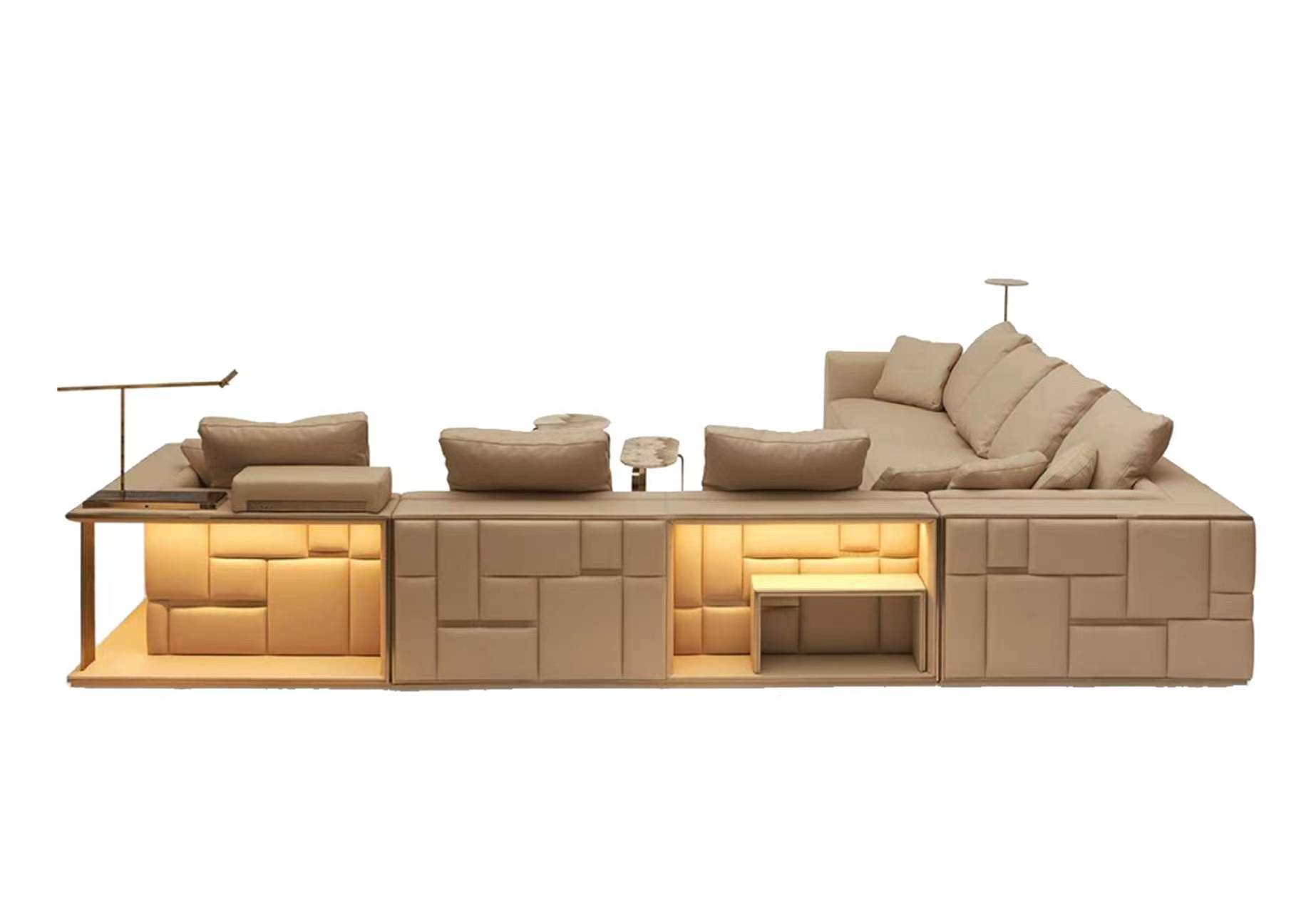
For piece-level detail, the Alba Palatial sculptural living suite and the BD-03 Art Deco leather Macassar sofa show how the drawing, the material schedule and the finished unit line up on one sheet. The about us page covers the workshop structure.
FAQ
How long does a contract furniture order from China take end to end?
Plan the sequence instead of a single number. Quotation and drawing time depends on how complete your brief is, then sampling, bulk production and ocean transit each consume their own window. Bulk does not begin before an approved sample exists, so build forward from the frozen brief and protect float at sampling and pre-shipment inspection.
Should a hotel FF&E buyer work directly with the factory or through an agent?
Direct buying keeps drawing interpretation, sampling and bulk production in one building, which shortens the loop when a technical question appears. Agents add value on multi-cluster programmes or where local inspection is required. The practical test is whether the person answering your technical questions owns the machines.
What should be confirmed before releasing a deposit?
A frozen specification set, an approved sample, named component makers and model numbers, a written packing assumption in cubic metres per unit, a documented inspection plan, and a stated ship window. If any of those exists only verbally, put it into the purchase order first.
Send the Drawings, Get the Calendar
If your 2026 programme is already drawn but not yet quoted, the drawing set is the only thing we need to start.
Reach our factory team on WhatsApp +86 188 2788 2512 with your room-type mix and destination port. You will get a quotation priced from those drawings, a packed CBM figure per SKU rather than a house estimate, and a direct answer on which parts of your schedule are realistic and which are not.