Choosing a Furniture Supplier for Multi-Property Rollouts
Running a multi-property rollout — whether you are outfitting a boutique hotel chain across three cities, equipping a serviced-apartment portfolio, or delivering FF&E for a mixed-use development — places enormous demands on your furniture supply chain. One misstep in material sourcing, quality consistency, or logistics planning can cascade into delayed openings, budget overruns, and reputational damage. At ROSY ROSE, we have supported developers, hospitality groups, and importers through exactly these kinds of programs for over four decades, and the patterns we see are consistent. The suppliers who earn long-term partnerships are the ones that demonstrate vertical integration, documented quality systems, and genuine scalability.
This article walks through the practical criteria that separate capable manufacturers from reliable manufacturing partners for multi-property rollouts. We cover what to audit before signing a contract, how to evaluate production and quality control capabilities, and which communication and documentation practices actually matter once the project is underway.
1. Manufacturing Scale and Vertical Integration
Multi-property rollouts require suppliers who can hold color, finish, and build consistency across large order volumes and extended timelines. The single most important signal is vertical integration — how much of the production process happens under one roof inside your own facility.
At ROSY ROSE, our 200,000㎡ base in Foshan is entirely self-operated. Core processes such as frame fabrication, upholstery, wood finishing, and assembly are not outsourced to third-party workshops. In our experience, outsourcing key工序 — especially joining, finishing, and upholstery — introduces variability that becomes expensive to correct during production runs of hundreds of units. When every step stays in-house, you get tighter tolerances, faster iteration on samples, and far fewer surprises on delivery.
- Look for a supplier that owns its primary production stages, not just its final assembly area
- Ask about factory floor space dedicated to your product category — upholstery, casegoods, lighting, or millwork
- Request photos or a virtual walkthrough of the production line, not just the showroom
- Verify that raw material warehousing sits within the same facility to reduce transit risk between process stages
2. Quality Control Systems That Stand Up to Audit
Quality assurance for a single-unit custom order looks very different from quality assurance for a rollout of 800 room sets. Buyers need documented inspection checkpoints, clear rejection thresholds, and traceability back to each production batch. Without these systems, you are relying on the supplier’s good faith rather than their process.
| QC Element | What to Ask For | Why It Matters |
|---|---|---|
| Inspection checkpoints | Number and timing of checkpoints in the process | More checkpoints spread across production catch defects earlier |
| In-process testing | Methods used before finishing (stability, joint strength, fabric pull-tests) | Prevents rework after final assembly when corrections are costliest |
| Final random inspection | Sampling plan and AQL levels applied per shipment | Ensures batch-to-batch consistency across containers |
| Documentation | Photographic records, inspection reports, and material test certificates | Creates an audit trail for your own QA team or third-party inspectors |
Every piece leaving our factory passes through 16 inspection checkpoints before it is approved for packing. These checkpoints cover dimensional accuracy, surface finish, hardware function, stitching integrity, and packaging security. We share inspection summaries with project managers so your team can review them alongside third-party inspection reports from SGS, Bureau Veritas, or your own QC staff.
3. Compliance with International Standards
Different markets impose different regulatory requirements on furniture. Fire safety, formaldehyde emissions, and structural performance standards vary between regions, and your supplier needs to understand and meet them — not just claim compliance on paper.
Common standards you will encounter across hospitality and commercial projects include:
- CARB P2 and TSCA Title VI for composite wood and upholstery substrates in the United States
- BS 5852 for upholstered furnitureign resistance in the United Kingdom and Middle East
- CAL TB 117 and its successor CAL TB 117-2013 for flame resistance in California and US hospitality
- BIFMA standards for office and contract furniture structural performance
- EN 16139 for seating strength and durability in European markets
When evaluating a supplier, request actual test reports from accredited laboratories, not summary statements on a certificate. Verify that the test reports correspond to the exact material compositions, foam densities, and construction methods specified in your contract. Suppliers that provide test data for the real products you will receive — rather than generic or outdated certificates — demonstrate a level of transparency that protects your project.
Our commitment to compliance is grounded in years of exporting to more than 125 countries, where regulatory expectations shift constantly. You can explore our full product range at our catalog page to see how different categories are engineered for specific markets.
4. Lead Time Management and Production Scheduling
One of the most common causes of rollout delays is unrealistic lead-time assumptions. Buyers sometimes receive quoted lead times that assume ideal conditions — no material shortages, no design revisions, no port congestion, and no customs holds. The reality of international furniture manufacturing almost never matches that baseline.
A reliable supplier will give you lead times that account for production sequencing, material procurement windows, and container loading optimization. They should also be able to break a large order into phased shipments that align with your construction schedule, rather than forcing you to receive everything in a single massive delivery.
In our experience, the projects that run smoothly share one practice: the supplier builds a detailed production schedule that is shared with the buyer at contract signing and updated weekly. This schedule tracks material procurement, in-process milestones, inspection completion, and estimated shipping dates. When delays occur — and they always do to some degree — an established schedule lets everyone adjust their downstream plans quickly instead of scrambling at the last minute.
5. Sample Approval and Pre-Production Validation
Never authorize bulk production without a formally approved sample. The sample approval process is not just about aesthetics — it is the only opportunity to validate construction methods, material hand-feel, joinery quality, and finishing consistency before hundreds of units are committed to the factory floor.
At our 100,000㎡ showroom, we prepare evaluation samples that reflect the exact materials, finishes, and construction specified for each project. Our clients typically request multiple rounds of revision before final sign-off, and we treat each revision as a necessary step in the partnership rather than an inconvenience. The cost of catching a specification issue at the sample stage is a fraction of the cost of correcting it after container loading has begun.
Before signing a production agreement, confirm with your supplier that:
- Samples will be built from the same materials and processes used in bulk production
- Revisions are included in the sample phase at no extra tooling or setup cost
- A pre-production meeting is held to review the approved sample, specifications, and packaging plan
- Written sign-off documentation is exchanged and retained by both parties
6. Logistics Coordination and Container Optimization
Multi-property rollouts involve large volumes of furniture that must be consolidated, packed, and shipped efficiently. Poor container loading planning can inflate freight costs by 15 to 30 percent compared to optimized stowage, and it can also increase the risk of transit damage when items are packed loosely to accommodate awkward shapes.
Your supplier should have a dedicated logistics team that develops container load plans using 3D visualization software. These plans specify exactly how each product category is packed, which components are pre-assembled versus knocked-down, and how palletization and container stuffing are sequenced. For complex rollouts, our team prepares a packing list for each container that cross-references order numbers, carton counts, and weights — information that your freight forwarder will need well before the cargo arrives at the port.
We also coordinate cross-docking and staging at our Foshan facility for projects that require phased delivery to multiple sites. This approach reduces the burden on your local receiving team and ensures that each shipment arrives in the sequence your construction schedule demands.
7. After-Sales Support and Spare Parts Provision
A rollout does not end when the last container is unloaded. Hospitality furniture faces heavy daily use, and replacement parts, touch-up kits, and occasional reorders for damaged or lost units are normal expectations — not exceptions. A supplier that disappears after delivery creates operational headaches that could have been avoided during the sourcing phase.
When evaluating potential partners, ask about their after-sales commitments upfront. Key questions include:
- What spare parts inventory is maintained, and how quickly can replacements be dispatched?
- Are touch-up kits and care instructions provided with each shipment?
- Does the supplier offer on-site support or remote technical guidance for installation teams?
- What is the policy and timeline for handling defective units discovered after delivery?
ROSY ROSE provides comprehensive after-sales documentation with every order, including parts lists, assembly guides, and maintenance recommendations tailored to your project. We also maintain a spares reserve for repeat orders, which significantly reduces wait times when properties need quick turnarounds between guest stays.
Conclusion: Building a Partnership, Not Just a Purchase
Multi-property rollouts succeed when the buyer and supplier operate as a coordinated team rather than as transactional parties. The criteria above — manufacturing depth, documented quality systems, regulatory competence, realistic scheduling, rigorous sample validation, logistics expertise, and committed after-sales support — are not checklist items. They are indicators that a supplier has the systems, experience, and mindset to handle the complexity your project demands.
If you are planning a rollout and want to discuss how a partnership with a manufacturer that has 40+ years of export experience and a fully integrated facility can work for your project, reach out to our team. We also offer bespoke collaboration through our bespoke program and design house for clients who need custom specifications aligned to brand identity.
What lead times can I expect for a multi-property hospitality rollout?
Lead times vary by product category and order volume, but our typical framework for large hospitality orders runs from sample approval through container loading in approximately 8 to 14 weeks. Phased delivery schedules can be arranged to match your construction timeline, and we provide weekly production updates so your team always knows the current status.
How does ROSY ROSE handle quality issues discovered after delivery?
We maintain a formal after-sales process that includes spare parts dispatch, remote technical support, and replacement unit production when warranted. Each project is covered by written quality terms agreed before production begins, and we coordinate closely with your inspection team and freight forwarder to resolve issues efficiently without delaying your opening schedule.
Can I visit the factory before committing to a large order?
Absolutely. We encourage all prospective partners to tour our 200,000㎡ facility in Foshan, inspect our production lines firsthand, and speak with our project management and quality control teams. Visiting the factory is one of the most effective ways to evaluate a supplier’s capabilities and build the confidence needed for a long-term rollout partnership.
Specifications
| Parameter | Specification |
|---|---|
| Overall Dimensions (W×D×H) | Configurable — standard example: 220 × 90 × 78 cm (86.6 × 35.4 × 30.7 in) |
| Seat Height | 45 cm (17.7 in) — adjustable within 42–48 cm range |
| Frame Material | Solid hardwood / powder-coated steel (specify by style) |
| Upholstery Options | Leather, performance fabric, or COM — see Customisation section |
| Finish Options | Lacquered, veneer, painted, or metal powder coat |
| Fill | High-resilience foam, 35–45 kg/m³ density |
| Weight per Unit | Approx. 28–42 kg depending on configuration |
| Packaging | 1 unit per carton; carton dimensions and CBM confirmed at quoting stage |
| Made to Order | Yes — all dimensions, materials, and finishes are configurable per project specification |
Materials & Construction
The frame is constructed from kiln-dried solid hardwood or structural steel, with joinery reinforced through mortise-and-tenon or welded joints depending on the product line. Every joint is tested for load-bearing stability before upholstery or finishing begins, ensuring long-term durability in high-traffic commercial environments.
Upholstery foams are selected within a 35–45 kg/m³ density range, calibrated for contract-grade resilience and sustained compression recovery. Leather options include full-grain and top-grain hides; fabric selections cover performance textiles meeting relevant abrasution and fire standards. Where applicable, finishes comply with CARB P2, TSCA Title VI, or EN 16139 requirements.
Each piece undergoes 16 inspection checkpoints before leaving the factory, covering dimensional accuracy, joint integrity, surface finish quality, and functional performance. This documented QC process is integral to maintaining consistency across multi-property orders.
Where It Works
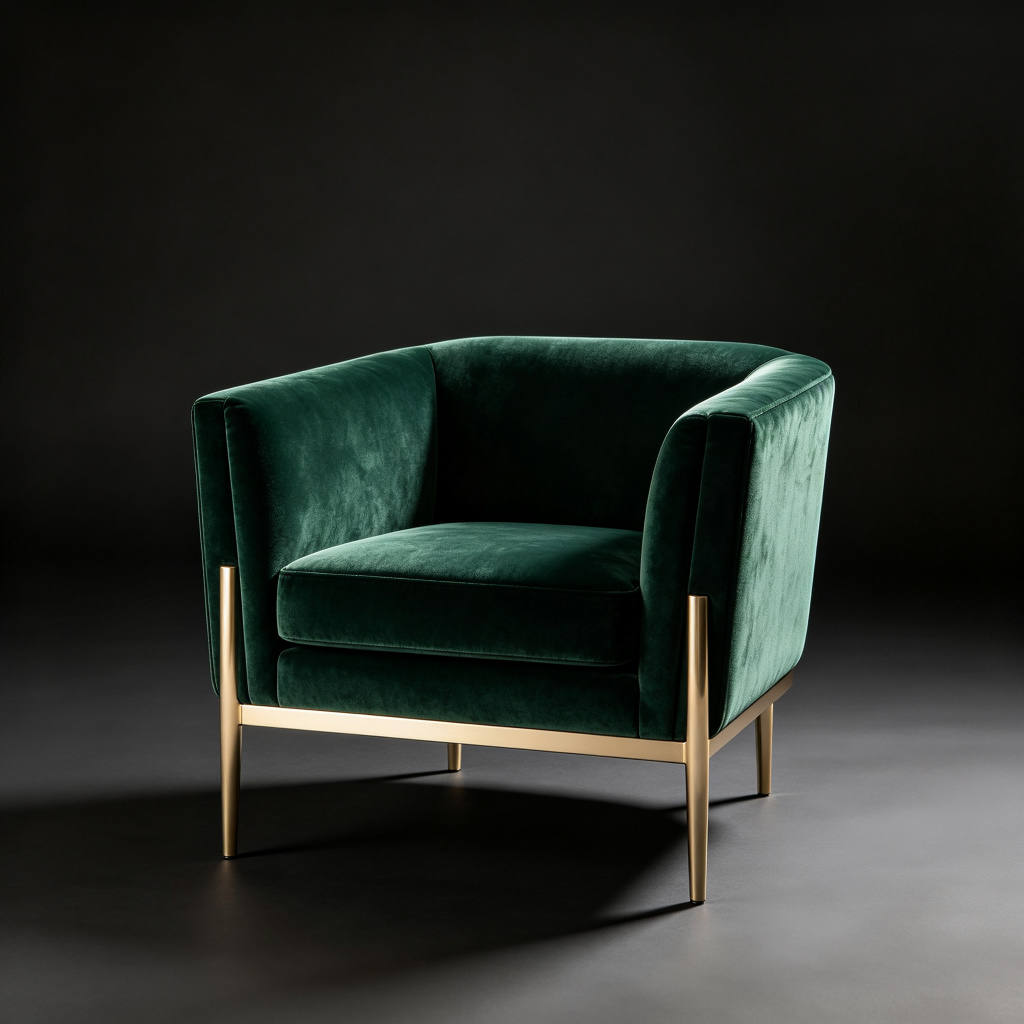
- Hotel lobby and lounge seating
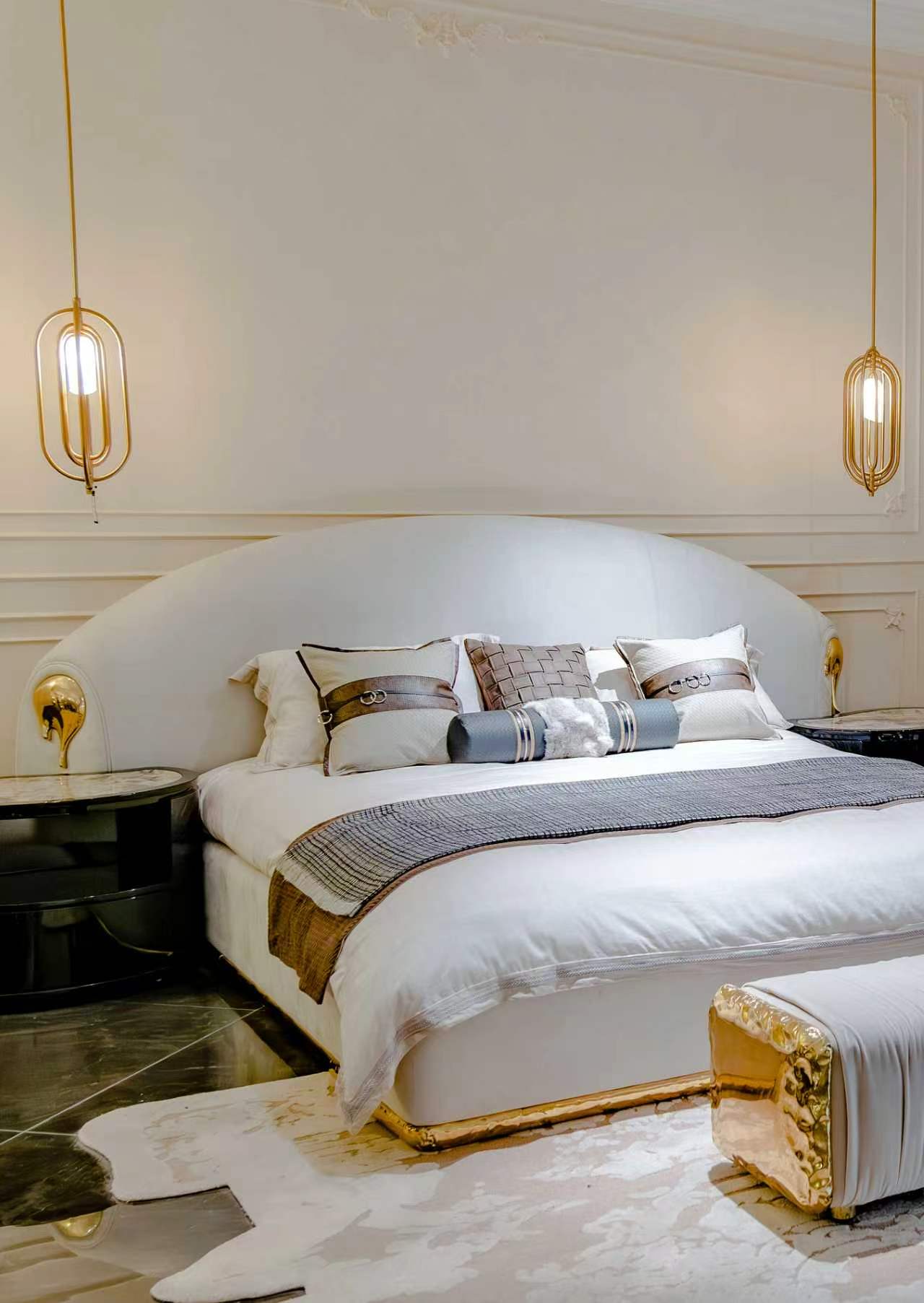
- Presidential and suite furnishings
- Members’ club and private dining
- Casino VIP lounges
- Executive airport lounges
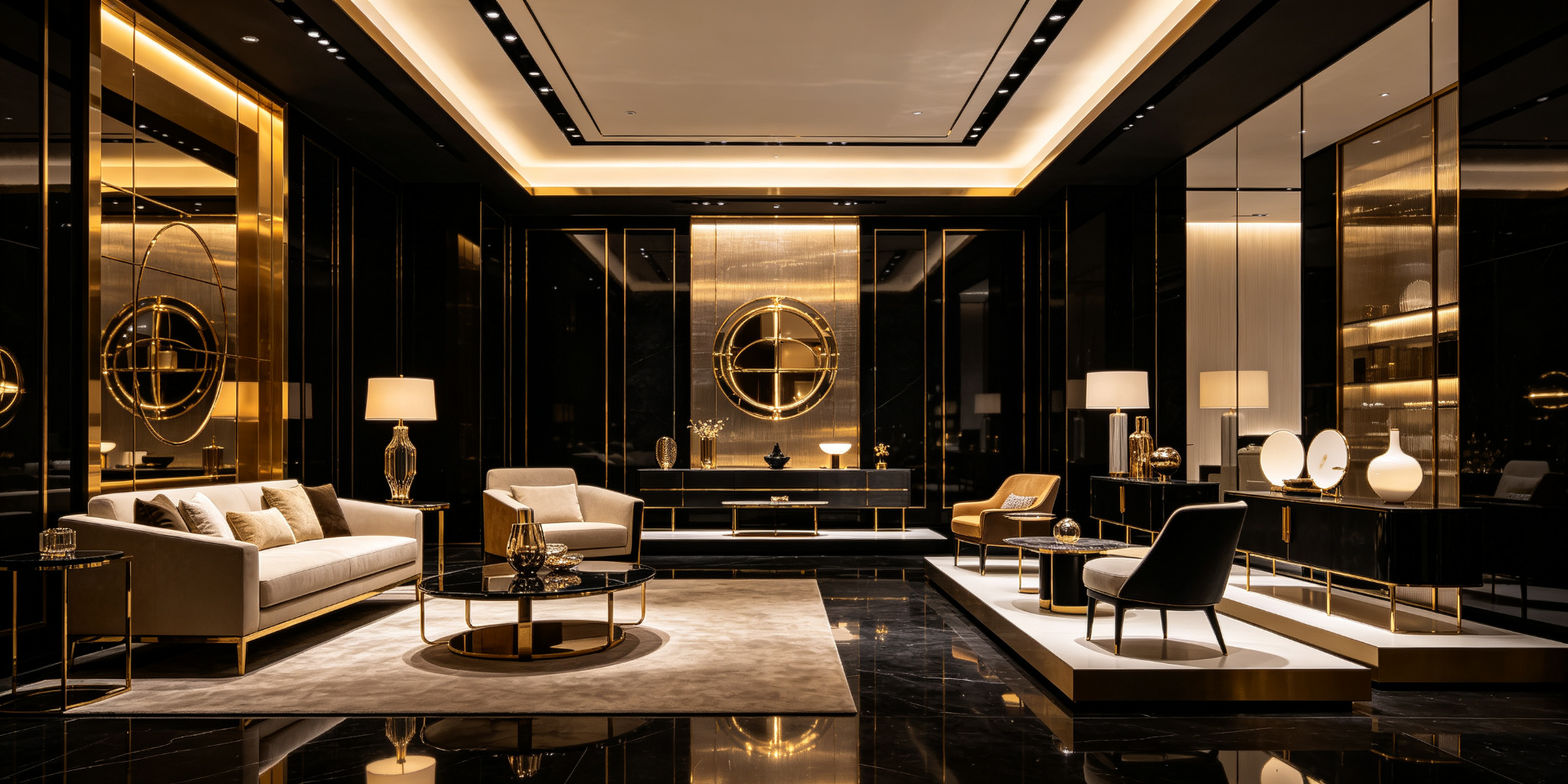
- Boutique showroom and display spaces
- Residence and serviced-apartment projects
These pieces are specified for environments that demand both aesthetic presence and commercial-grade longevity. The configuration options allow the same design language to carry across diverse property typologies within a single portfolio.
Customisation Options
- Dimensions: Width, depth, height, and seat height all adjustable to project drawings
- Fabric & Leather: Full catalogue selection or COM (customer-supplied material) accepted
- Finish: Lacquer colour, wood veneer species, metal powder-coat shade — all configurable
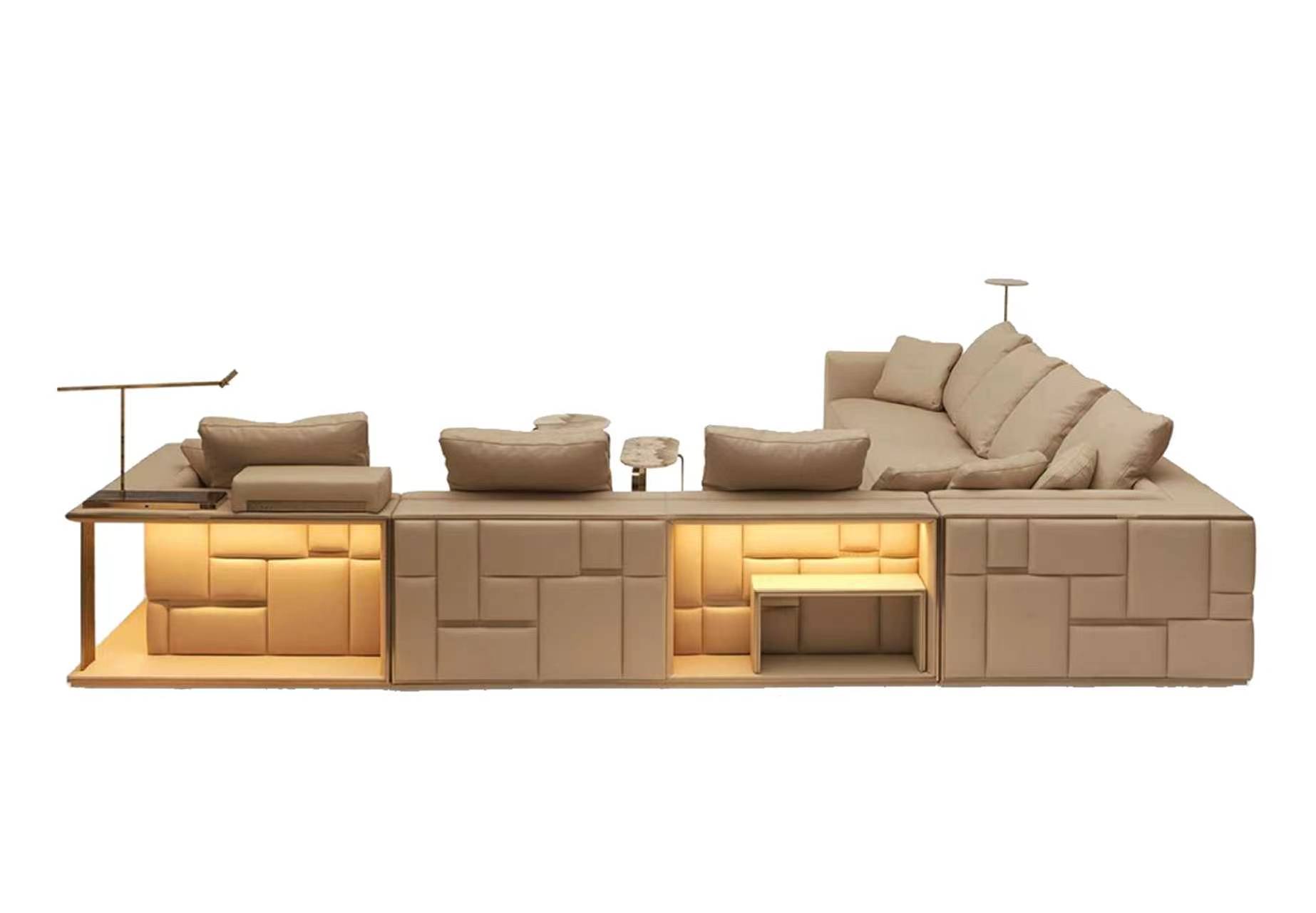
- Layout & Configuration: Modular arrangements and corner variants available for large-scale projects
All custom specifications are confirmed via approved drawings before production commences, ensuring alignment between design intent and final delivery.
Ordering, Lead Time & Logistics
Project orders have no fixed MOQ — volumes are scoped per contract. The workflow begins with a technical query and sample approval phase, followed by production once drawings and materials are signed off. Typical lead time ranges from 6 to 10 weeks depending on order size and customisation level.
Packaging is designed for sea-freight shipment with reinforced carton protection and moisture-resistant wrapping. We ship FOB Foshan or EXW from our 200,000㎡ facility. Shipping documentation, loading plans, and container consolidation are managed in coordination with the buyer’s freight forwarder.
Frequently Asked Questions
What quality certifications does ROSY ROSE hold?
ROSY ROSE has over 40 years of B2B export experience across 125+ countries. Our products can be manufactured to comply with recognised industry standards including CARB P2, TSCA Title VI, BIFMA, BS 5852, CAL TB 117, and EN 16139. Specific certification documentation is provided upon request for each product line.
Can you supply matching pieces across multiple hotel properties?
Yes. Because all core processes — frame fabrication, upholstery, wood finishing, and assembly — are carried out in-house at our Foshan facility, we maintain colour, finish, and build consistency across large multi-site orders. Lot numbering and batch records are maintained for traceability.
What is the sample approval process?
We produce a physical sample or prototype based on your specifications before bulk production begins. You review and approve the sample, after which final drawings and material selections are confirmed in writing. Production starts only after written sign-off, minimising the risk of variation between sample and delivery.